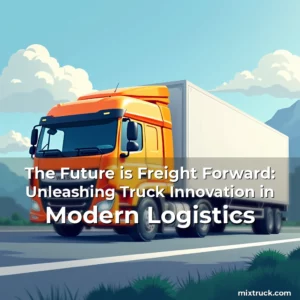

The Future of Freight: Revolutionary Innovations Reshaping Trucking Industry Landscapes
In an era where transportation demands are evolving at breakneck speed, the trucking industry is undergoing a transformation that promises to redefine efficiency, sustainability, and safety standards. From autonomous driving technologies to zero-emission powertrains, modern innovations are steering commercial vehicles toward a future that was once confined to science fiction.
This evolution isn’t merely about incremental improvements—it’s a complete reimagining of how goods move across continents. The integration of smart logistics systems, advanced telematics, and AI-driven route optimization has created a dynamic environment where traditional paradigms are being challenged daily.
Redefining Efficiency Through Smart Logistics Systems
Smart logistics systems represent one of the most transformative advancements in trucking technology today. These integrated platforms leverage real-time data analytics to optimize delivery routes, reduce fuel consumption, and enhance fleet management capabilities.
By utilizing GPS tracking combined with machine learning algorithms, companies can predict traffic patterns weeks in advance and adjust schedules accordingly. This predictive capability reduces idle time by up to 30%, significantly improving overall operational efficiency.
- Real-Time Inventory Management: IoT sensors embedded within cargo containers provide continuous monitoring of temperature, humidity, and product integrity during transit.
- Dynamic Route Optimization: Advanced software continuously recalculates optimal paths based on live traffic conditions, weather forecasts, and road closures.
These systems also enable seamless communication between drivers, dispatchers, and warehouse managers through centralized digital dashboards. Such connectivity ensures that every stakeholder remains informed about shipment status without requiring manual updates.
Pioneering Autonomous Driving Technologies
Autonomous trucks have emerged as game-changers in addressing labor shortages while enhancing highway safety. Companies like TuSimple and Embark are leading the charge with semi-autonomous prototypes capable of handling long-haul freight operations.
Current models utilize LiDAR sensors, radar detection systems, and high-definition mapping to navigate highways safely. While full autonomy remains a work in progress, these vehicles already demonstrate significant potential in reducing human error-related accidents.
Regulatory frameworks around self-driving trucks vary globally but show increasing acceptance as pilot programs yield positive results. In Arizona, for instance, state authorities have approved limited commercial testing of autonomous tractor-trailers since 2018.
Powertrain Revolution: Zero-Emission Solutions
The push towards sustainable transportation has accelerated the development of alternative powertrain solutions. Electric trucks from manufacturers such as Tesla Semi and Daimler Trucks North America are setting new benchmarks in emissions reduction.
Battery-electric vehicles offer several advantages including lower maintenance costs due to fewer moving parts compared to conventional diesel engines. However, challenges remain regarding charging infrastructure expansion and battery longevity under heavy-duty usage scenarios.
Hydrogen Fuel Cell Technology Emerges
While electric propulsion dominates headlines, hydrogen fuel cell technology presents another viable option for decarbonizing freight transport. Companies like Nikola Motor Company are developing hydrogen-powered trucks that promise longer range capabilities than current EVs.
Refueling stations for hydrogen vehicles require specialized equipment and substantial capital investment. Despite these hurdles, early adopters report refueling times comparable to traditional diesel trucks—approximately five minutes versus hours required for battery charging.
Advanced Telematics and Fleet Management
Fleet telematics has evolved beyond basic GPS tracking to encompass comprehensive vehicle health diagnostics and driver performance metrics. Modern systems collect vast amounts of data that inform preventive maintenance strategies and fuel economy improvements.
Data analytics tools now identify patterns indicative of potential mechanical failures before they occur. For example, abnormal engine vibrations detected via onboard sensors can trigger automated service alerts ensuring timely repairs.
Driver behavior monitoring features help reduce reckless driving habits by providing feedback reports that highlight instances of speeding, harsh braking, or excessive idling—all factors contributing to increased fuel expenditure and accident risk.
Safety Enhancements Through Intelligent Driver Assistance
Intelligent driver assistance systems (IDAS) play a crucial role in mitigating risks associated with fatigue-induced errors and distracted driving behaviors. Features like lane departure warnings and automatic emergency braking have become standard in many modern commercial vehicles.
Camera-based monitoring systems track driver alertness levels using facial recognition technology. If signs of drowsiness are detected, the system initiates gentle auditory alarms prompting the driver to take rest breaks.
Collision avoidance systems employ radar and camera fusion techniques to detect obstacles within proximity ranges. When imminent collision threats arise, these systems intervene automatically by applying brakes or adjusting steering inputs when necessary.
Digital Twin Technology for Predictive Maintenance
Digital twin technology creates virtual replicas of physical assets enabling engineers to simulate various operating conditions remotely. This approach allows for extensive testing without risking damage to actual vehicles.
By integrating sensor data from real-world counterparts, digital twins update themselves in real time reflecting precise operational states. Engineers can then run stress tests under simulated extreme temperatures or terrain variations to anticipate wear-and-tear effects accurately.
Such simulations facilitate proactive replacement scheduling rather than reactive repair measures which often result in unexpected downtime losses affecting supply chain continuity.
Blockchain Integration for Transparent Supply Chains
Blockchain technology introduces unprecedented transparency into global supply chains by creating immutable records of each transaction involved in transporting goods. This feature enhances accountability among stakeholders ranging from shippers to customs officials.
Cryptographic hashing ensures that any attempt to alter recorded information becomes instantly detectable preventing fraud or misrepresentation claims related to cargo origins or compliance documentation.
Smart contracts built upon blockchain networks automate payment processes contingent upon successful completion milestones defined beforehand. This automation minimizes administrative overheads typically associated with traditional invoicing procedures.
Conclusion
The convergence of technological breakthroughs across multiple domains signals a paradigm shift within the trucking sector poised to reshape its very foundation. As we’ve explored—from intelligent routing algorithms to quantum computing applications—the future holds immense possibilities yet to be fully realized.
Mixtruck enthusiasts and industry professionals alike must stay attuned to these developments shaping tomorrow’s mobility landscape. Embracing emerging trends will ensure continued relevance amid rapid transformations occurring at both macroeconomic and micro-operational levels simultaneously.